Golf Club Loft Guide
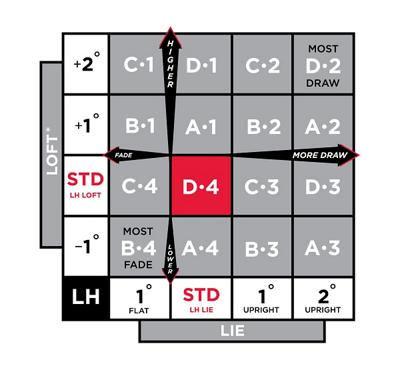
Posted By admin On 13.01.20Lie Angle If you’re tall or short, and/or have an unusually shallow or steep swing, you may want to think about visiting your local club professional who can check whether the lie angle of your irons is appropriate. At the point of impact, if the head of the is too flat (i.e. The toe points down) it can drag on the grass, acts for an instant as a pivot, and causes the plane of the face to tile towards the right – which is where the ball will go. If the lie is too upright, the heel of the club will dig in and cause pulled shots to the left.
As a rule, shorter golfers will generally benefit from slightly flatter lies; taller golfers may need them tweaked upright a little. Most manufacturers do offer in a variety of different lies – but generally only as a special order. So how do you tell whether the lie is correct on your clubs? The technology for testing this is very simple. Your local pro should be able to help, and what they’ll do is put some masking or impact tape on the sole of the club – and gets you to hit some balls off a lie testing board (essentially a black strip of hard plastic). This leaves a mark or hole in the tape when you hit a ball off it.
If everything is hunky dory, the tape will be marked where the centre of the sole is and the clubs are fine. If it’s marking towards the toe, lie angle is too flat, and towards the heel, too upright. It’s worth noting that because an incorrect lie angle causes the plane (and therefore, loft) of the club to become tilted, getting the lie angle correct is much more important on short than long irons. Once you’ve established whether or not the lie angles need tweaking, most clubs can be usually altered in a matter of minutes by your local pro for a modest fee, well worth paying. Lofts Similarly, it is also worth having the lofts of your clubs checked, say, once a year. If you’re playing a lot of golf with forged clubs – which are made of softer metal – it might even be worth having them checked more regularly.
Club heads are just bits of metal – and hitting them regularly on the ground (as you do withevery shot) will over time inevitably bend them out of whack to some extent.Even brand new clubs straight from the factory have a tolerance which might beplus or minus 2 degrees. So why is it important to check them? Club heads are just bits of metal – and hitting them regularly on the ground (as you do with every shot) will over time inevitably bend them out of whack to some extent. Even brand new clubs straight from the factory have a tolerance which might be plus or minus 2 degrees. So why is it important to check them? With thanks to Ping Golf, here is the specification table for their G5 irons. You’ll see that there is 3 to 4 degrees of loft (equating to roughly 10-15 yards distance) between each club.
So, the loft on the 3 iron is 21 degrees, and on the 4 iron 24degrees etc. If, for example, on your own set your 7 iron loft was, let’s say, a couple of degrees week (ie more lofted) and your eight iron a couple of degrees strong (ie less lofted) it could mean that both clubs have exactly the same loft – and you could be hitting both clubs the same distance! This scenario is not as unusual as you might think – so, go on, get your lofts and lies checked, give your local club pro some well-deserved business, and do your golf game a favour at the same time. We hope this short guide has proved helpful. If you need any further information – or, indeed, if you think we can improve our explanation of loft and lie – feel free to phone one of our PGA Professionals on 0208 401 6901 – or email They are here Monday-Friday between 9:00 and 18:00 to help and offer advice should you require it.
Research shows that around a quarter of all shots are played using a wedge so clearly they are a vital part of every golfer’s game. They can create birdies or save pars, but can also cause problems for golfers who struggle around the greens if they are not using the right type of wedge for the shot. It is essential that the wedges you carry add to your game and assist scoring. Wedges may appear as basic clubs that are not as advanced in terms of technology as a driver or irons, but this is untrue.
Different types of wedges along with varying specifications mean you should research and find a wedge that is suits to your swing and needs. Types of Wedges Wedges can be divided into four main types: Pitching Wedges (PW) The first and most common wedge is the pitching wedge. Typically with a loft between 44-48 degrees it is used primarily for full shots into greens and some longer chip shots. Most modern sets tend towards a lower lofted or stronger pitching wedge to blend in with longer-hitting iron designs, whilst also creating a need or gap for the, aptly named, gap wedge. Gap Wedges (GW) As the name suggests these wedges fill the ‘gap’ between the pitching wedge and the sand wedge. Occasionally referred to as an attack (AW) or utility wedge (UW), these wedges tend to carry a loft of around 50 to and 53 degrees.
Largely suited to fuller shots, they are typically added to player’s bag to bridge a distance gap and offer more variety near the green for pitches that don’t involve a full swing and longer chips. Sand Wedges (SW) Usually in the range of 54 to 58 degrees, the sand wedge was originally designed, as the name suggests, to escape from green side bunkers thanks to the heavier and wider design of its sole.
For a long time it was the go-to club for chips and bunker shots around the green, because it was the highest lofted club in a player's bag until the lob wedge came along. Lob Wedges (LW) Lob wedges are the newest of the wedge designs. As its name suggests it has a high loft of around 60 to 64 degrees, allowing golfers to produce more height and spin with shots near the green. It tends to be used more to hit chips, flop shots and bunker shots than full shots. Loft The loft of a wedge is simply the angle created between the face of the wedge and an imaginary vertical line. The more loft on a wedge, the more elevation on your shot, resulting in a higher ball flight with less distance, as seen below: Most professional carry three or four wedges, to offer variation and selection to their short games.
The key in choosing a set of wedges is to make sure that there are no big gaps in loft between the lowest lofted iron in your set and the first wedge and then also between edge wedge. Try to keep the lofts gaps to around 4 degrees between each club. Bounce The ‘’ of a wedge is the area of the club that hits the turf, hence ‘bounces’ the club through the surface under the ball at impact. Bounce is the group name for the elements involved in sole design: the bounce angle, sole width, leading edge, rocker and camber of a wedge.
Most discussions on bounce refer more specifically to bounce angle. The bounce angle is the angle from the leading edge to the point where the sole actually meets the ground. Whilst many people think wedges sit flat on the ground, this is not true.

Bounce, and specifically the bounce angle, is added to prevent a wedge from digging into sand or turf, stopping the momentum of the club through the ball. Low Bounce Wedges Wedges with a bounce angle of 4 to 6 degrees are considered low-bounce. Wedges with minimal bounce will be better suited to players who sweep the ball, taking a shallower divot, firmer turf conditions (i.e. Links courses) and heavy, coarse sand in bunkers or bunkers with little sand. Mid Bounce Wedges Any wedge with 7 to 10 degrees of bounce is considered to be a mid-bounce wedge.
Golf Club Loft Guide
It will be the most versatile option, suited to a wider range of conditions and swing types. High Bounce Wedges High bounce wedges have more than 10 degrees of bounce, meaning the leading edge sits higher when the sole is rested on the ground. High-bounce wedges are best suited to players who dig at impact, taking deep divots, softer conditions (i.e.

Parkland courses) and bunkers with deep fine sand. For more information read our. Sole Grinds As you are busy grinding away on the course, trying to save par, manufacturers are busy grinding wedges in a way to help players hit better shots. So what is a sole grind? In basic terms, the sole grind refers to the additional shaping of the sole of the wedge usually around the heel or the toe. More wedge manufacturers are now offering offer a range of sole grinds in addition to the standard wedge sole. They literally grind the soles with a machine to suit specific turf conditions or shots.
For instance a heel grind will remove material from the heel of the sole to allow the face to sit lower to the ground so it is easier to open the face at address. However sole grinds also change the bounce of the sole so it is important to receive advice from a teaching professional on the types of grinds that will suit your game. Finishes Once a wedge has been made, it is given a finish to offer a distinct look and colour. This is purely down to personal preference and taste as different finishes will have almost identical levels of feel. However it is important to know how each finish will wear over time.
Finishes such as Chrome or Nickel will maintain their colour and appearance longer. Unplated or raw finishes are designed to wear or rust more over time, which can improve friction and lead to improved spin. Darker finishes look great initially but over time the paint will wear off on the sole and face to give some nice wear marks if you like that sort of thing.
Shafts Virtually all wedges come with steel shafts unless the wedges are part of a graphite set of clubs. Most steel shafted wedges also come with a standard 'wedge' flex. This is actually more like a stiff shafted steel shaft in flex, but designed specifically for the shorter club.
It provides maximum feel and accuracy and in such a short club, the flex is less important. 1985 honda magna 700 repair manual. For more information on shafts, go to the Golfalot.TV: How To Choose Your Wedge.