Fox Float Shock Ctd Evolution 29 Manuals
Posted By admin On 24.01.20
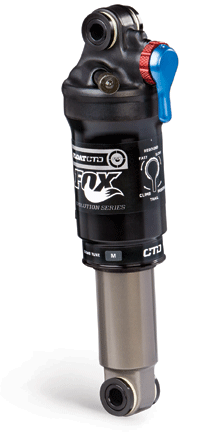

You are here: Rear Shocks FLOAT FLOAT CTD - Evolution FLOAT CTD - Evolution lengths & travels 5.5 x 1.0; 6.0 x 1.25; 6.5 x 1.5; 7.5 x 2.0; 7.875 x 2.0; 7.875 x 2.25; 8.5 x 2.5 model features, adjustments CTD: lever actuated 3-position Climb/Trail/Descend, air spring pressure, rebound, angled air valve for easier access, lightweight chassis.: remotely actuated 3-position Climb/Trail/Descend, improved remote mechanism, air spring pressure, rebound, angled air valve for easier access, lightweight chassis. Spring air riding styles XC, trail, AM Installing Your Shock If you are installing your shock on a bike for which the shock is not original equipment:. Install the shock. Remove the main air chamber air cap and let all the air out of the main air chamber. Carefully cycle the suspension through its entire travel. Check that all parts of the shock are clear of the frame and swingarm as it cycles through the travel. Pressurize your main air chamber to a minimum of 50 psi and no more than 300 psi.
You will tune to a more specific air pressure in the section below. General Maintenance There may be a small amount of air sleeve lubricant residue on the body.
This is normal. If this residual air sleeve lubricant is not present, this is an indication that the air sleeve should be re-lubricated. Some other things to consider for all shock models:. If you ride in extreme conditions, service your shock and air sleeve more frequently. For your shock.
Wash your shock with soap and water only. Do not use a high pressure washer to clean your shock. Internal service should be performed by FOX Racing Shox or an.
Before You Ride. Clean the outside of your shock with only mild soap and water, and wipe dry with a soft dry rag. NOTE:Do not use any solvents or de-greasers, as these products can damage the shock's exterior finish or its anodized parts. Do not spray water directly on the seal/shock body junction.
Do not use a on your shock. Inspect the entire exterior of your shock. The shock should not be used if any of the exterior parts appear to be damaged. Or for further inspection or repair. Make sure that your quick-release levers (or thru-axle pinch bolts) are properly adjusted and tightened. Check your headset adjustment. If loose, adjust it accordingly to your bicycle manufacturer's recommendations.
Check that all brake cables or hoses are properly fastened. Test the proper operation of your front and rear brakes on level ground. Setting Sag., and compare your result to the sag setting shown in the table below. Air Spring Setting Guidelines Shock Travel (in./mm) 25% Sag (in./mm) 1.00/25.4 0.25/6.4 1.25/31.7 0.31/7.9 1.50/38.1 0.38/9.5 1.75/44.4 0.44/11.1 2.00/50.8 0.50/12.7 2.25/57.1 0.56/14.2.
If your measured sag value doesn't match the table value, add or release air pressure in 5 PSI increments:. if your measured sag value is less than the table sag value, screw on the pump fitting, note the current air pressure setting and depress the black bleed-valve to reduce the gauge pressure by 5 psi. If necessary, measure and set sag again and repeat this adjustment. if your measured sag value is greater than the table sag value, screw on the pump fitting, note the current air pressure setting and pump to increase the gauge pressure by 5 psi. If necessary, measure and set sag again and repeat this adjustment. Repeat until your target sag is achieved, then replace the air valve cap. With an easy flip of the blue CTD lever, you will quickly achieve optimum rear suspension performance for all types of riding terrain.
Climb mode: engages the firmest low-speed compression setting for maximum pedaling efficiency. Trail mode: a moderate low-speed compression setting for an optimal blend of pedaling efficiency and bike control, in undulating riding terrain.
Fox Float Ctd Psi
Descend mode: sets the low-speed compression setting to fully open, for plush absorbency and maximum bike control on steep, aggressive descents. The blue CTD lever switches your riding platform modes. Rotating 120° between Descend mode position (shown below), change to Trail mode (when the CTD lever is positioned in line with the shock), and Climb mode (when the CTD lever is turned all the way clockwise, to the left). Adjusting Rebound Rebound controls the rate at which your shock returns after it has been compressed. The proper rebound setting is a personal preference, and changes with rider weight, riding style and conditions. A rule of thumb is that rebound should be as fast as possible without kicking back and pushing the rider off the saddle.
The rebound control has 12-15 clicks of adjustment. For slower rebound, turn the red adjuster control clockwise. For faster rebound, turn the red adjuster control counter-clockwise.